
Is the 9F Student Visa right for your studies?
The 9F is intended for foreign students who will begin a regular course of study at an accredited university, college (a higher-education institution) or comparable educational institution in the Philippines. The school or university must support your application and act as the responsible institution in its dealings with the Bureau of Immigration (BI – the Philippine immigration authority).

Which dates and deadlines must you plan for?
- Before enrolment: Obtain written confirmation that the educational institution is authorized to admit foreign students and support your specific course under the 9F procedure.
- From age 18: The 9F generally applies to a regular course of study above high-school level (the Philippine secondary-school qualification).
- Before applying: You need the admission letter and the educational institution’s formal endorsement.
- During the procedure: Your existing immigration status must remain valid until BI has decided the 9F application.
- During your studies: Extensions follow your academic progress and are prepared together with the educational institution.
- During the first 60 days of each calendar year: Complete the Annual Report (the yearly registration with BI).
Which requirements apply to the 9F?
You must be at least 18 years old, and your course must be above Philippine high-school level. The educational institution must be authorized to admit foreign students and support the visa procedure.
When are you more likely to need a study permit?
For language courses, short programs, many non-degree courses and many cases involving minors, a Special Study Permit (SSP – additional authorization to study) is more likely to be appropriate.
Which BI fee should you budget for?
The fee for conversion to 9F is PHP 9,720 (Philippine pesos – the national currency), about USD 157 (US dollars – the comparison currency) at USD 1 = PHP 62, plus USD 50 for the ACR I-Card (BI’s foreign-national identity card).
When does the 9F fit your plan?
The 9F fits when a regular course of study is the genuine primary purpose of your stay.
- You have been admitted to a recognized educational institution.
- The institution actively supports the procedure.
- You can document sufficient funds for your studies and living expenses.
The 9F is not suitable if enrolment is intended merely to obtain some form of immigration status. In that case, consider a 9A (Tourist Visa) for a temporary stay, a 13A (Marriage Visa) if you are married to a Filipino citizen, a 9G (Work Visa) for local employment, or the Special Resident Retiree’s Visa (SRRV – long-term status for eligible applicants).
Why is the school decisive for your application?
The school or university not only issues the admission letter but normally also guides the procedure through a contact person accredited by BI.
Before paying substantial tuition fees, ask for written answers to these five questions:
- Is the institution authorized to admit foreign students?
- Who is the designated BI contact person?
- Which documents does the school provide for the application?
- Is your course genuinely eligible for a 9F?
- Does the school also support later extensions?
If the institution cannot answer these questions clearly, you should not assume that the visa can later be obtained without difficulty.
When do you need an SSP instead of a 9F?
The SSP is not a separate immigration status. It is additional permission to learn or study while your underlying stay is based, for example, on a valid 9A.
An SSP is often used for language courses, short certificate programs, other non-degree courses, and students who are minors. You must still continue to extend your normal immigration status. The SSP does not automatically become a separate student visa.
Families with school-age children and people planning a language course should clarify this distinction before enrolment.
How does the 9F application work step by step?
After you have been admitted, the educational institution prepares the application together with you.
- When do you begin? As soon as the admission letter is available and your existing immigration status is valid for the procedure.
- Where do you file the application? The accredited educational institution files it at the authorized BI office.
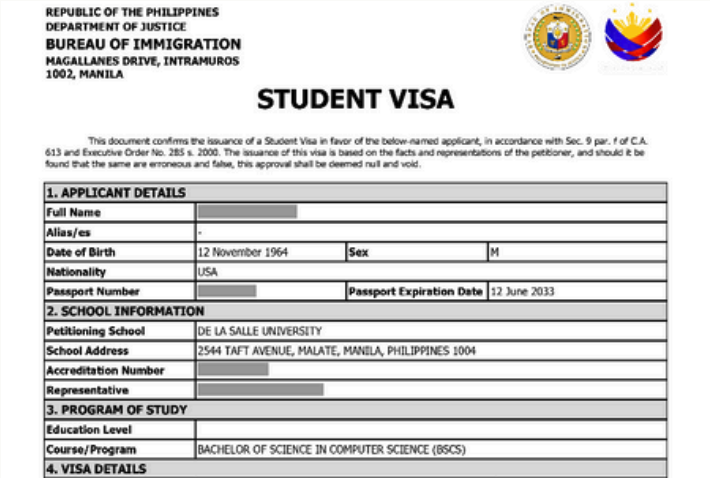
- What do you bring? Your passport, current proof of authorized stay, BI application form, school or academic records, evidence of funding, passport photographs and further documents required by the school and BI. The school adds the admission letter and its formal endorsement.
- What happens next? BI reviews the documents and issues the Order of Payment Slip (BI’s payment assessment). After payment, you receive the Official Receipt (the government payment receipt). Your photograph and fingerprints are then captured, and the ACR I-Card is applied for at the same time.
- How do you receive the visa? After approval, BI enters the 9F visa in your passport. You receive the ACR I-Card later.
- How do extensions work? The educational institution prepares them with you according to your academic progress.
- What do you keep? Keep the admission letter, a complete copy of the application, payment assessment, official receipt, passport with the 9F visa entry and ACR I-Card.
What does the 9F cost?
The BI fee for conversion to 9F is PHP 9,720 (about USD 157 at USD 1 = PHP 62).
Additional costs include USD 50 for the ACR I-Card, tuition fees, translations, an apostille (an international authentication certificate) or consular authentication (verification by the responsible Philippine mission), depending on the issuing jurisdiction, notarizations, possible medical examinations, police records, travel and processing costs, and later extension fees. The actual total cost therefore depends heavily on the school and course.
Which documents should you obtain from the relevant issuing country?
Before departure, ask the educational institution which documents it requires for your course and in which form it will accept them.
- school records
- academic records
- diplomas or degree certificates
- birth certificate
- evidence of funding
- police clearance
- passport
- certified English translations for documents issued in another language
- an apostille or consular authentication from the responsible Philippine mission, depending on the issuing jurisdiction
Which official sources apply?
Use the current BI checklist and the guidance of your accredited school for the application and extensions.
- Bureau of Immigration: Student Visa (9F)
- Bureau of Immigration: Current 9F Application Checklist
- Bureau of Immigration: Special Study Permit
- Bureau of Immigration: Currently Accredited Educational Institutions
- Bureau of Immigration: 2025 Procedures Manual
- Bureau of Immigration: Annual Report
- Bureau of Immigration: FAQ on Student Visa and Study Permission
What is the bottom line?
The 9F works well when you are planning a genuine regular course of study and the school supports the process reliably. For a language course, a short program or many cases involving minors, an SSP or another immigration route is often more suitable.
Consultation: Before enrolment, we assess whether your proposed course is eligible for a 9F or whether you need an SSP or another status.
Information current as of 15 July 2026. Fees, filing channels and requirements can change; the latest official guidance and the payment assessment issued by the responsible authority are controlling. USD planning rate on this page: USD 1 = PHP 62; conversions are rounded from the Bangko Sentral ng Pilipinas reference rate published for 3 July 2026.
 No more ad blocks with a Supporter subscription!