
Resident & Investor Visa
Special Investor's Resident Visa (SIRV)
The SIRV is not a retirement visa with a nicer name. It is a residence status for real investors. The visa question and the money question are connected: first check whether the investment form, banking route and documentation required by the Board of Investments (BOI – the Philippine investment authority) qualify for the SIRV, then move the money.

In 30 Seconds
- Minimum investment: USD 75,000 or equivalent in recognized foreign currency under BOI rules.
- The money is not a fee and not a Special Resident Retiree’s Visa deposit (SRRV – retirement and long-stay visa), but investment capital with banking, documentation and market risk.
- The SIRV is suitable only if you genuinely want to invest and the specific investment form is permitted, can be documented and can be maintained.
- For predictable long-term residence without investment risk, the SRRV is usually the clearer comparison.
Who is it for?
Investors aged 21 or older who want to bring capital into an eligible Philippine investment, document it and maintain it.
What is the core?
Your status depends on a real, provable investment. Without qualified investment, BOI documentation and ongoing proof, there is no SIRV.
What does it not cover?
SIRV is not intended for retirement, marriage, a local job, real estate purchase or cheap permanent residence.
What must be right before the application?

- Age and nationality: The principal applicant must be at least 21 years old and eligible under the current BOI and foreign-affairs rules. Confirm nationality eligibility before transferring money.
- Capital: at least USD 75,000 or equivalent in recognized foreign currency in an eligible investment form.
- Eligibility: no conviction for moral turpitude, no dangerous, contagious or comparably severe disease and no institutional treatment for a mental disorder or disability.
- Family: Spouse and unmarried children under 21 can be considered as dependents; the status is tied to the principal applicant and typically ends upon marriage or reaching the age limit.
- Process: BOI reviews the investor, capital route and investment part; the Bureau of Immigration (BI – the Philippine immigration authority) enters the visa status in the passport.
Is SIRV better than SRRV?
Only if you really want to invest. SRRV answers the residence question: deposit, fees, predictable long-term status. SIRV answers a different question: can your capital work in an eligible Philippine investment, be documented and carry your residence status at the same time?
If you simply want to live quietly, the SIRV is often unnecessarily complicated. If you are already planning a Philippine investment structure anyway, the SIRV may be a good fit.
What happens to the USD 75,000?
The money does not go to Immigration as a fee. Under BOI rules, it must be placed into an eligible investment form and documented. Examples named include equity holdings in eligible corporations, certain projects under the Investment Priorities Plan (IPP – BOI list of priority investments), manufacturing or service companies and, under certain conditions, government securities.
Private real estate purchases are not the standard solution for this: a condo, a lot or a private house purchase does not replace SIRV investment proof. That means you carry normal investment risk: market, liquidity, exchange rate, bank, broker, tax and exit. Statements like "just buy blue chips" are only reliable once the specific investment form and BOI eligibility have been checked.
How does SIRV work in practice?
First comes the preliminary check: age, nationality, residence status, family, capital source and planned investment form. Then come documents, clearances, medical, bank/remittance proof, the deposit at a BOI-accredited depository bank and the BOI evaluation.
Under BOI rules, BOI may first issue a probationary multiple-entry SIRV (provisional status with repeated entry) for six months. Within 180 days from issuance, the deposit must be converted into an eligible investment and documented with matching stock, broker, corporate-secretary or government-securities proof. Anyone already in the Philippines must keep their Tourist Visa (9A – temporary visitor status) valid during this time.
What are costs and duties after the application?
The main fixed amount is the USD 75,000 investment. In addition, there are government fees, the ACR I-Card (Philippine foreign national identity card), bank and transfer costs, documents, English translations where needed, apostilles or consular authentication (verification by the responsible Philippine mission), depending on the issuing jurisdiction, clearances, medical examinations, travel and professional advice. For fees, the current Order of Payment (official payment assessment) is what counts, not an old internet table.
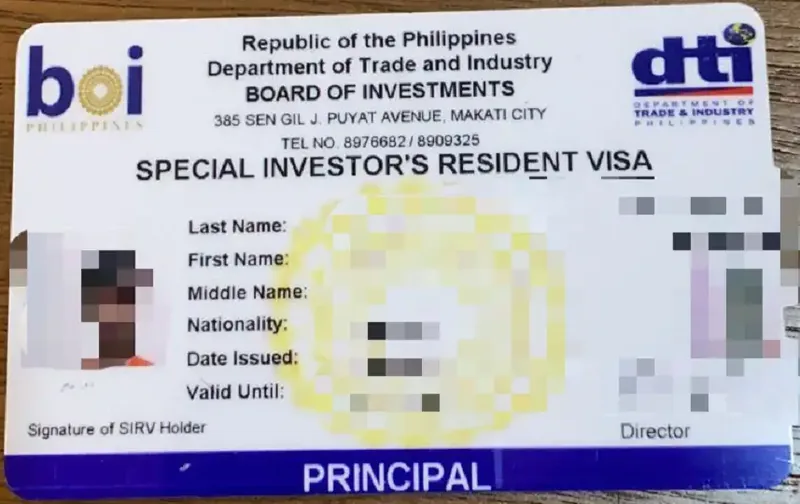
As a SIRV holder, you are not a normal tourist. You must keep the ACR I-Card and BOI/BI records current and monitor reporting, departure and re-entry requirements. The BOI-issued SIRV ID (investor visa identity card) generally has to be renewed annually; at least one month before expiry, the investment and status records must be in order. If the investment is to be changed or sold, clarify beforehand whether BOI approval is needed and whether the status remains valid.
Which question must be answered before every transfer?
Does this exact investment qualify for the SIRV? Not roughly. Not verbally. This exact investment, with this exact contract, through this exact bank route. The most expensive mistake is to transfer first to any account and ask afterwards whether it fits.
Before moving money, you need clarity on capital source, accredited bank, recipient, ownership proof, holding obligations, sale rules, currency risk, tax consequences and BOI documentation.
Bottom line: SIRV is not a shortcut visa
SIRV can be strong when investment, reporting discipline and residence goal fit together. It is weak if you are only looking for a quiet long-term status. Then first compare SRRV, 13A, Balikbayan or 9A properly.
Check before transfer
With the SIRV, the order of the steps matters. We first check visa eligibility, documents, capital route, deadlines and exit questions. The investment, tax and contract decisions should also be reviewed by qualified professionals.
Official Sources
Fees and requirements from BI and BOI can change. Before applying or renewing, always check the current requirements with the responsible authority.
 No more ad blocks with a Supporter subscription!